





Key Takeaways
- Multi-currency month end close involves more than recording transactions and preparing financial statements.
- Foreign currency receivables, payables, bank accounts and exchange-rate movements need to be reviewed at period end.
- A consistent close process should include bank reconciliations, FX reviews, general ledger checks and management reporting.
- Businesses should document how exchange rates are selected and applied across accounting and tax processes.
- Reconciliations help identify missing transactions, timing differences, incorrect rates and unexplained balances.
- Outsourced accounting Singapore support can help businesses manage bookkeeping, reconciliations, FX adjustments and month end reporting.
- Clear responsibilities between the business and accounting provider help maintain appropriate review and approval controls.
- A structured month end close can improve financial visibility while reducing manual rework as the business grows.
What Is a Multi-Currency Month End Close?
A month end close is the process of completing and reviewing accounting activities for a financial reporting period.
For a business operating in only one currency, the process may be relatively straightforward.
For a multi-currency business, additional work may be required.
A Singapore company might:
- Invoice customers in US dollars
- Pay overseas suppliers in euros
- Receive funds into foreign currency bank accounts
- Maintain its primary accounting records in SGD
- Hold foreign currency receivables or payables at month end
- Translate financial information for reporting purposes
These transactions can create foreign exchange differences that need to be identified and recorded appropriately.
The Inland Revenue Authority of Singapore (IRAS) recognises that foreign currency transactions can create exchange differences when monetary items such as debtors and creditors are translated into a business's functional currency. The tax treatment can also differ depending on the nature of the foreign exchange difference.
This is why a multi-currency month end close needs more than simply converting every balance into SGD.
Why Multi-Currency Month End Close Can Be Challenging
Foreign currency accounting introduces additional steps into an already busy month end process.
Different Transaction Currencies
Sales, purchases, expenses and bank transactions may originate in different currencies. The accounting team needs to ensure that transactions are recorded using the appropriate currency and exchange-rate methodology.
Foreign Exchange Differences
Exchange rates can change between the transaction date and settlement date. They can also change between the original transaction date and the reporting date for outstanding monetary balances.
This can result in foreign exchange gains or losses.
Multiple Bank Accounts
A company operating internationally may have several bank accounts in different currencies. Each account needs to be reconciled against the accounting records.
Foreign Currency Receivables and Payables
Outstanding invoices denominated in foreign currencies may need to be reviewed and revalued at period end.
Reporting in Singapore Dollars
A Singapore business may use a foreign currency as its functional currency in certain circumstances. IRAS states that companies preparing financial statements in a non-SGD functional currency must prepare their tax computations in that same functional currency, while amounts declared in the Corporate Income Tax Return must be in SGD. This makes having a clearly documented currency process particularly important.
What Should Be Included in a Multi-Currency Month End Close?
A good month end process should cover more than transaction posting. The exact checklist depends on the business, but common activities include:
A consistent checklist helps prevent important activities from being missed during a busy close.
How Foreign Exchange Entries Fit Into Month End Close
Foreign exchange accounting is one of the areas that can make multi-currency month end close more complicated.
Consider a simple example.
A Singapore company records an invoice from an overseas supplier in USD. At the time of the transaction, the USD amount is recorded using the applicable exchange rate. If the invoice remains unpaid at month end, the SGD equivalent may differ because the exchange rate has changed. The accounting team may therefore need to recognise the appropriate foreign exchange difference based on the applicable accounting treatment.
IRAS explains that foreign exchange differences can arise when foreign-currency monetary items such as debtors and creditors are translated into the functional currency. It also notes that the accounting and tax treatment of foreign exchange differences can differ, meaning businesses need appropriate tracking and documentation.
This is one reason why a multi-currency close should include a dedicated FX review rather than treating foreign exchange as an afterthought.
Why Reconciliations Matter
Reconciliations are an important part of a reliable month end close. A reconciliation compares the accounting records with another source of information to identify differences.
For example:
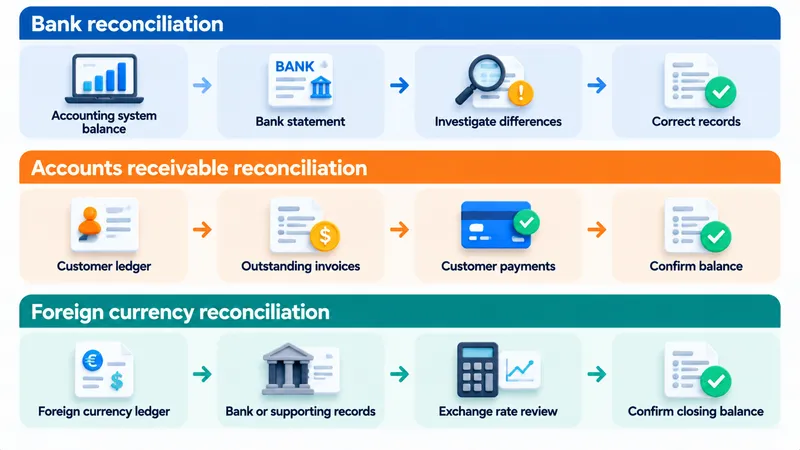
The objective is not simply to make the numbers match. Differences should be investigated and understood.
IRAS requires companies to maintain proper financial records, including source documents, accounting records, schedules and bank statements, and generally requires these records to be retained for at least five years from the relevant Year of Assessment.
Good reconciliation procedures therefore support both financial reporting and record-keeping requirements.
Building a Better Multi-Currency Close Process
Businesses can make month end close more manageable by standardising the process.
1. Define the Functional and Reporting Currency
First, establish which currency is used for the business's financial reporting and understand how foreign currency transactions should be handled.
The functional currency is based on the primary economic environment in which the business operates.
Under Singapore's financial reporting framework, companies need to determine the appropriate functional currency for financial reporting.
2. Document Exchange Rate Policies
The business should have a documented approach for determining which exchange rates are used for different accounting activities.
This can help avoid situations where different teams use inconsistent rates for similar transactions.
For Goods and Services Tax (GST) purposes, IRAS also has specific requirements for foreign currency transactions, including the use of an approved exchange-rate source and consistent application of the selected source.
Accounting and tax requirements should therefore be considered separately where necessary.
3. Reconcile Foreign Currency Bank Accounts
Each foreign currency bank account should be reconciled regularly.
This helps identify:
- Missing transactions
- Duplicate entries
- Unrecorded bank charges
- Timing differences
- Incorrect exchange rates
- Unexplained balances
4. Review Outstanding Foreign Currency Items
At month end, review outstanding receivables and payables denominated in foreign currencies.
The review should identify which balances remain outstanding and whether exchange-rate movements require accounting adjustments.
5. Review FX Gains and Losses
Foreign exchange gains and losses should be reviewed rather than simply posted and ignored.
A useful review can help identify:
- Large month-on-month movements
- Unexpected currency exposure
- Incorrect exchange rates
- Settlement differences
- Unusual transactions
6. Prepare a Management Reporting Pack
Once the accounts have been closed and reviewed, management should receive information that helps them understand the company's financial position.
Depending on the business, the reporting pack could include:
- Profit and loss statement
- Balance sheet
- Cash flow information
- Accounts receivable ageing
- Accounts payable ageing
- Cash position
- Foreign currency exposure
- FX gains and losses
- Budget versus actual results
- Key financial commentary
The purpose is to turn accounting data into information that management can actually use.
When Should a Business Consider Outsourced Accounting Singapore Support?
Not every business needs to build a large internal accounting team. Outsourced accounting can be particularly useful when a business is:
Expanding Internationally
A company that starts dealing with customers and suppliers in multiple currencies may find its accounting requirements becoming more complex.
Managing Multiple Entities
Groups with subsidiaries, branches or related companies may need more structured reconciliations, reporting and financial controls.
Growing Quickly
Transaction volume can increase faster than the internal finance team can comfortably manage.
Short on Accounting Resources
A business may not want to hire a full-time team for every accounting function, particularly when its accounting needs fluctuate.
Preparing for Better Management Reporting
Some companies have accounting records in place but lack a consistent month end reporting process that gives management timely financial visibility.
Using Cloud Accounting Software
Businesses using cloud accounting software can combine accounting technology with professional accounting support.
What Does an Outsourced Accounting Provider Handle?
The scope depends on the agreement between the business and its accounting provider. For a multi-currency business, outsourced accounting support may include:
- Day-to-day bookkeeping
- Bank reconciliations
- Accounts payable
- Accounts receivable
- Foreign currency transaction recording
- FX adjustments
- General ledger review
- Month end close
- Management reporting
- Financial statement preparation
- GST-related accounting support
- Audit preparation
- Tax-related accounting schedules
We provide outsourced accounting support on a monthly, quarterly or annual basis, with the scope tailored to your transaction volume, reporting requirements and business needs.
The important point is to define responsibilities clearly. A business should know:
- What the accounting provider handles
- What the internal team handles
- Who approves entries
- Who provides supporting documents
- Which reports are produced
- When the month end close is completed
- How unusual transactions are escalated
How to Make Month End Close More Efficient
A cleaner process is not necessarily about doing more work. It is about reducing unnecessary rework.
1. Use a Standard Close Checklist
A checklist gives the accounting team a consistent sequence to follow every month.
2. Set Clear Deadlines
Set cut-off dates for invoices, expense claims, payroll information and supporting documents.
3. Automate Where Practical
Cloud accounting software can reduce manual data entry and provide more timely access to financial information.
4. Investigate Exceptions
Instead of manually checking every transaction in the same way, identify unusual balances, unexpected movements and unreconciled items for further review.
5. Keep Supporting Documents Organised
Supporting documents should be easy to locate if a transaction needs to be reviewed later.
6. Separate Preparation and Review
Where practical, the person preparing the accounts should not be the only person reviewing them.
This creates an additional layer of control.
Multi-Currency Controls Businesses Should Consider
A multi-currency accounting process should also include appropriate controls.
Useful controls can include:
These controls also support the broader requirement for companies to maintain accounting records that properly explain their transactions and financial position and enable true and fair financial statements to be prepared.
The right controls depend on the size and complexity of the business. A small company with limited foreign currency activity may need a simpler process than a group operating across several countries.
Common Multi-Currency Month End Mistakes
Businesses can run into problems when the process is inconsistent.
1. Using Different Exchange Rates Without a Clear Policy
Different teams may calculate similar transactions differently.
2. Leaving Reconciliations Until the Last Minute
This can create a backlog of unexplained differences just before reporting deadlines.
3. Treating All FX Differences the Same Way
Accounting and tax treatment may not always be identical.
IRAS specifically highlights differences between accounting and tax treatment for certain foreign exchange differences.
4. Ignoring Small Foreign Currency Balances
Small balances can accumulate and become difficult to explain later.
5. Closing Without Reviewing Unusual Movements
A completed close does not necessarily mean a properly reviewed close.
6. Producing Reports Without Commentary
Management may see the numbers but still not understand why they changed.
Benefits of Outsourced Accounting for Multi-Currency Businesses
The value of outsourced accounting goes beyond reducing the bookkeeping workload. A well-structured arrangement can provide:
1. More Consistent Processes
A defined close procedure makes month end activities easier to repeat and review.
2. Access to Accounting Expertise
Businesses can access professional accounting support without necessarily building a large internal finance team.
3. Better Financial Visibility
Regular reconciliations and reporting give management a clearer view of financial performance and cash position.
4. Scalable Support
Accounting support can be adjusted as transaction volumes, currencies and reporting requirements change.
5. More Time for Management
A structured accounting function reduces the time management spends chasing entries, reconciliations and financial information.
How Futre Supports Outsourced Accounting in Singapore
We support businesses with outsourced accounting and bookkeeping tailored to their accounting requirements, transaction volume and reporting needs. For businesses that need support beyond accounting and bookkeeping, we also provide tax advisory and related compliance services.
Our services can cover day-to-day bookkeeping, bank reconciliations, financial statement preparation, cloud accounting integration and audit support. For businesses managing multiple currencies, we can also help establish practical processes for recording transactions, reconciling accounts, monitoring foreign exchange movements and preparing management reports.
Our accounting solutions can support multiple currencies, including SGD, USD and GBP, depending on the service arrangement and your business requirements.
The right accounting setup depends on the size and complexity of your business. We work with you to establish practical processes that keep your financial records organised, reporting consistent and your finance function ready to support business growth.
Conclusion
A reliable multi-currency month end close gives management a clearer view of financial performance, cash flow and foreign exchange exposure.
We help businesses strengthen their accounting processes with structured reconciliations, accurate reporting and practical multi-currency controls. With the right outsourced accounting Singapore support, your finance function can stay accurate, compliant and ready to support business growth.
Need a more reliable month end close? Talk to Futre about your accounting requirements.
Frequently Asked Questions
What is outsourced accounting in Singapore?
Outsourced accounting means engaging an external accounting provider to manage some or all of a company's accounting activities instead of handling everything with an internal finance team. Services can include bookkeeping, reconciliations, financial reporting and compliance support.
Why is multi-currency accounting more complicated?
Businesses dealing in multiple currencies need to account for foreign currency transactions, exchange-rate movements, foreign currency balances and potentially foreign exchange gains or losses. The process becomes more complex when the business also has multiple bank accounts or entities.
What is a month end close?
A month end close is the process of completing, reconciling and reviewing accounting records for a financial period before financial reports are prepared.
Does outsourcing accounting mean giving up control?
No. A business can outsource accounting tasks while retaining approval, review and decision-making responsibilities internally. Clear workflows should define who prepares, reviews and approves accounting entries and reports.
Can outsourced accounting support businesses using multiple currencies?
Yes. The appropriate scope depends on the business's accounting system, currencies, transaction volume and reporting requirements. Providers may support foreign currency bookkeeping, reconciliations, FX adjustments and reporting as part of the engagement.
How long should Singapore companies keep accounting records?
IRAS generally requires companies to retain relevant financial records, including source documents, accounting records and bank statements, for at least five years from the relevant Year of Assessment.